
December 10, 2025
The pathway to medalling can look a little different dependent on whether you are an athlete or a coach.
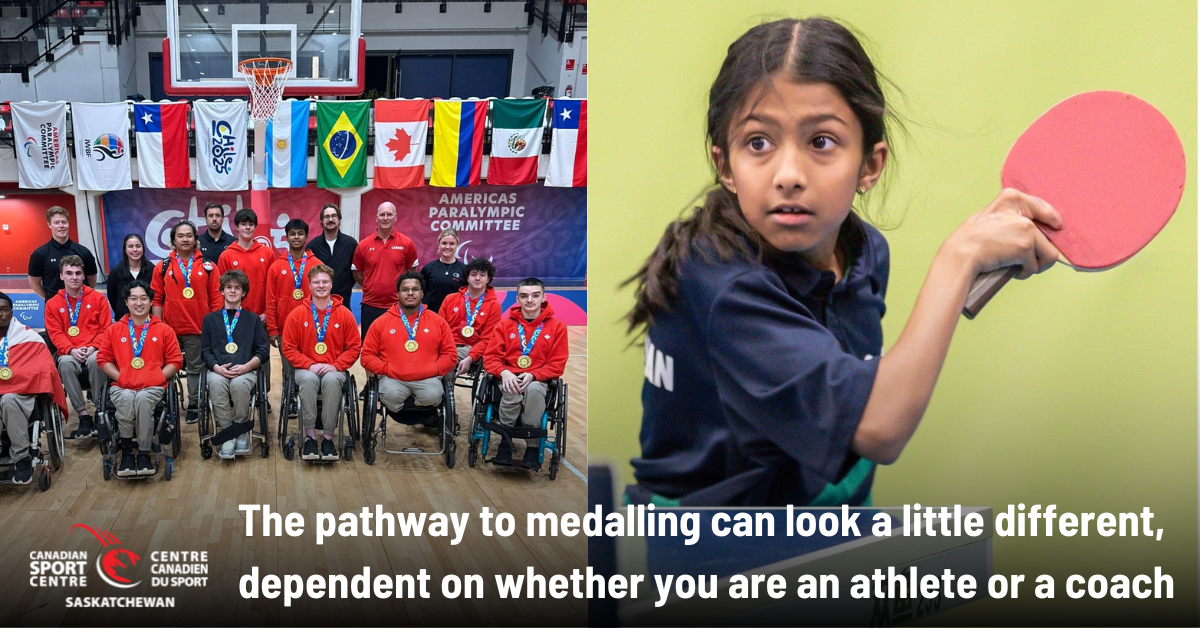
Guided by different experiences and expectations, Para table tennis player Thulir Hector and assistant wheelchair basketball coach Jared Sajtos, both claimed medals in their respective sport at the Chile 2025 Youth Parapan American Games in November.
The world-class Para sport competition plays hosts to thousands of athletes representing 30 different countries. Among those competing was fourteen-year-old Hector, Canada’s second youngest athlete to attend this year.
Hector is no stranger to representing her province and her nation, but that does not mean she is exempt from the nerves of competition.
“I was really scared, but I have experience because I went to the Brazil Parapan Am. I had a lot of experience from then and it was pretty much the same thing. I also got a lot of training in Ontario before I left,” shared Hector.
Even with her previous experience on the international stage, Hector can still be overcome with apprehension during her matches. But it is in those moments she remembers the power of taking a deep breath and honing-in on her training.
That ability to recentre herself is what led her to win quarterfinals 3-0 before falling 3-1 in the semifinals to claim bronze, Canada’s first medal of the Games.
After standing on the podium, Hector was later shocked to discover she was the first Canadian athlete to medal at the event.
“It was really cool. I didn’t know until a couple days after,” laughed Hector. “Of course it was a really big honour.”
A similar honour was felt by Sajtos, who supported the U23 men’s 5×5 and U25 women’s 3×3 teams through to claim gold, contributing to the seven tallied by Canada.
With it being his first international event as coach, capturing gold was the very result he hoped to achieve.
“The goal at these events is to win and if you have fun through the way, that’s great. But we did achieve the overall goal for both our teams.”
And according Sajtos, he believes he played a minor role in his teams’ success.
“In terms of actually guiding the teams, I don’t know if it necessarily fair to say I was guiding them there. In my opinion, once you hit the event, a lot of the success on court comes from the athletes,” said Sajtos. “It’s on the athletes themselves to really want it and work hard for it. My job is almost like an auxiliary to help them be successful.”
Guided by that philosophy, Sajtos helped build the team for success before they even travelled to Chile to compete. He would spend a lot of intentional time with the athletes, often taking to the court himself to join in practice.
In his five years of coaching, Sajtos has learned that the power to succeed is all in the preparation beforehand and leaving the on-court aspect in the hands of the athletes.
The proof can be seen in the results, with both teams going undefeated 7-0.
“We provided them with opportunities to show their abilities,” said Sajtos. “It was obviously successful for us, with both of our teams medalling with gold. The athlete pool we had for both men and women were very strong. There was lots of good leadership there.”